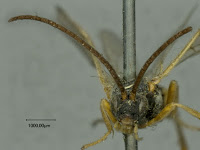
Showing posts with label Canadian fauna. Show all posts

June 24, 2013

More pictures of Canadian species of Microgastrinae

For the past two months I have been really busy finishing a large paper on Apanteles from Mesoamerica -which will be mentioned in a future post here. During that time I have received invaluable help from many people, and without them I would not be able to finish the job, not even close. Two of the most helpful among my long list of "guardian angels" have been Caroline Boudreault and Henri Goulet from the CNC -well, to be honest, they have supported me for over seven years...

Caroline and Henri have been taking hundreds of photos for the paper mentioned before. As a "byproduct" of their work, we have ended with some new pictures of species previously described from Canada. In this post I share color photos for three of those species, to be continued in future posts with more species.

The three species of today were described and partially illustrated in a 2010 Zookeys paper, but the pictures shown below are new and provide more morphological details. Altogether with the images from Zookeys -which can also be freely accessed and downloaded- we now have a much better documentation of those species... hopefully more Canadian microgastrines will follow this trend.

Apanteles huberi Fernández-Triana, 2010. This species will be the focus of an additional post, due to the fact that it is very close to Apanteles fumiferanae Viereck, 1912 -which has already been featured in this blog. Both species show are very similar morphologically, and their DNA barcodes are also remarkably close. Stay tuned for more details on why they are different...

Apanteles huberi, lateral view. Photo taken by Caroline Boudreault and Henri Goulet (CNC).

March 18, 2013

Photos of four Nearctic species of Microgastrinae

I have been too busy lately -and should continue to be that way until mid April or so. For that reason, my contributions to this blog for the next few weeks will be more limited than what I would like. 

This post is to share colour photos and basic comments on distribution and hosts of four Nearctic species of Microgastrinae, with the hope of expanding that information in the near future. It is part of a long-term effort to build a virtual library (of images, biological, ecological and taxonomic information) about braconid species parasitoids of caterpillars -in North America and hopefully beyond. As far as I know, the photos shared below are the first colour photos available for those species -if I am wrong, please let me know!


1- Glyptapanteles compressiventris. This is a widely distributed species in the Holarctic (Nearctic, Eastern and Western Palearctic). It has been reared mostly from the Lepidoptera family Arctiidae (eight hosts species recorded), with a couple of questionable records from Noctuidae and Tortricidae.
Glyptapanteles compressiventris specimen from the Canadian National Collection of Insects, Ottawa. Photo taken by Caroline Boudreault and José Fernández-Triana.

February 7, 2013

The taxonomic conundrum of Cotesia xylina and Cotesia yakutatensis

One of the main purposes of this blog is to provide comments on species of Microgastrinae that are of interest to a broader audience. I am still thinking on how to organize those posts to make them more useful to potential users, and hopefully soon will come with a system to do that. In the meantime, I am tagging them with the label "Species Profile", to make it easier to search and retrieve that kind of data.

Today I will briefly comment on two Nearctic species of Cotesia that present an interesting challenge to taxonomists and biocontrol workers alike: Cotesia xylina (Say, 1836) and C. yakutatensis (Ashmead, 1902).  Both species are only found in the Nearctic region, although yakutatensis has a wider and more northern range, extending up to Alaska in the West and up to Greenland in the East.
Distribution of Cotesia xylina and Cotesia yakutatensis. Data taken from Taxapad (2012). The coloured areas represent the Provinces/States where the species have been recorded, but no information on exact localities is shown here.

Both species have been reared from several species of Lepidoptera, mostly from the family Noctuidae, with some of the hosts representing agricultural pests. The validity of some records is questionable, especially the ones from Pyralidae and Sphingidae -those were reported in papers before 1920 (mostly late XIX century), and the wasps species may just have been missidentified.


C. xylina has been recorded parasitizing eight species of caterpillars: Epiglaea apiata, Mamestra configurata, Peridroma saucia, Xestia c-nigrum, Xylena nupera (all noctuids), Evergestis rimosalis (Pyralidae), Lampara bombycoides, and Smerinthus jamaicensis (Sphingidae). As written above, the last two records are suspicious.

As far as I know, there is no published paper providing illustrations or drawings of C. xylina, so here I present one colour photo taken a couple of years ago in the CNC.  

January 23, 2013

A braconid wasp in the COSEWIC List?

The Committee on the Status of Endangered Wildlife in Canada (COSEWIC) exists to provide Canadians and their governments with advice regarding the status of wildlife species that are nationally at risk of extinction or extirpation. Its committee of experts assesses and designates which wildlife species are in some danger of disappearing from the national territory. As part of  its work, COSEWIC produces a Candidate List of species. I strongly recommend to anyone interested in the protection of the Canadian nature to visit the COSEWIC website, and to support their work and that of similar organizations. [Disclaimer: I do not work for COSEWIC, nor I am involved with their efforts in any capacity].

My interest in COSEWIC, and the reason I am writing this post today is to discuss the POSSIBILITY of including a parasitoid Braconidae wasp within their list. Is that a real thing? Or am I just getting too excited with my subject of research?

Let's look at the facts and try to be impartial. COSEWIC List includes quite a few arthropods species. Which in itself is something truly amazing, especially in this world that usually focus its conservation efforts in large, charismatic fauna -conservation efforts also prioritize the flora, but I will leave plants out of this comment and will restrict myself to animals for the time being. 

Small animals, like insects, tend to be almost completely overlooked... unless they are "charismatic" by themselves, e.g. a beautiful butterfly, a conspicuous bumble bee, a colorful ground beetle, a large dragon fly, etc. But a small parasitoid wasp (2.5 mm long)... are you kidding me? Who cares about THAT?

Well, as they say "no harm in trying", and I am trying today to present the case for a first parasitoid wasp to be considered by COSEWIC: the microgastrine species Apanteles samarshalli Fernández-Triana, 2010.
The species was described very recently, in 2010, from specimens found mostly in southern Florida, United States (Everglades and the Florida Keys). I have also found additional specimens in two countries of Central America (data from unpublished studies). 

But, the original description also recorded the species from one Canadian locality: Rondeau Provincial Park, in southwestern Ontario. Rondeau truly honours its reputation of having species commonly found at much southern latitudes, because the single specimen collected there (in August of 1973, and deposited in the Canadian National Collection of Insects, Ottawa) happens to be, by far, the northernmost known for the species.

January 10, 2013

Numbers matter

This week I was talking to my colleague Caroline Boudreault about the numbers of Braconidae specimens, species, and primary types that we currently have in Ottawa (Canadian National Collection of Insects, CNC). Caroline, an extremely skillful and knowledgeable person when it comes to braconids, had been asked to revise and update the number of primary types here.  

Primary types (i.e. holotypes, syntypes, lectotypes, and neotypes, as defined by Articles 73-75 of the International Code of Zoological Nomenclature) are usually one of the main factors considered when evaluating the weight of a collection. The more the types, the higher a collection is ranked. Because primary types are name-bearing specimens. 

So, how good is the CNC in terms of Braconidae types? According to Taxapad, there are almost 300 institutions worldwide storing primary type material of braconid wasps, altogether representing 20,007 type specimens. And, according to that source, Ottawa is the 5th largest collection in the world, with 683 types (see pie chart below).


Number of primary types (mostly holotypes) stored in 272 collections of Braconidae worldwide (after Taxapad, 2012).

When Caroline added some new data that is not yet in Taxapad, the number rose to more than 720. And then we will be incorporating over 200 new holotypes within the next couple of months (I will write about that development in a future post). Thus, in round numbers, the CNC collection of Braconidae is approaching the one-thousand-types mark. 

Of course, beyond the number of primary types it is also important to know the number of specimens overall, the geographic coverage of the collection per se, and its curation state. We do not know those figures with the same precision as for the types, but below I share what have found out so far.

There are almost 60 cabinets, each with 29 drawers, for a total of over 1,600 drawers with braconid wasps in the CNC (a previous summary mentioned 1,500 drawers of Braconidae, but that number has increased steadily in the past two years). Based on that, and on a conservative average number of specimens/drawer,  my tentative estimate would be around half million of specimens. And that only represents the mounted/pined material; there is a huge collection in alcohol (several thousand vials, as mentioned here), where many more thousands specimens await to be processed and incorporated to the main (dry) collection.

January 3, 2013

Canadian Microgastrinae described by L. A. Provancher. Part II

This is the second part of a work about Canadian species of Microgastrinae described by Provancher in the XIX century. In all cases, the photos shown are the first ever to be taken to those holotypes, and are now available for anyone interested and/or working with the group. More information on the Provancher species will be soon made available through this blog and other websites.

Microplitis quadridentatus (Provancher, 1886). The original name given to the species was Microgaster 4-dentatus. Its known distribution is mostly Northeastern United States and Ontario, although it has also been recorded from South Dakota -suggesting a likely wider distribution in North America. It has been reared from two species of the Noctuid genus Simyra. 


December 16, 2012

Braconid wasps and forest pests in Canada

In a previous post, I analyzed some interesting data coming from the Canadian Forest Pest Management Forum. I could find at least 119 species within 20 families of caterpillars (Lepidoptera) that have been mentioned as pests of some kind to our forests in the past few years. As a taxonomist working with braconid wasps, my next logical step was then to see how many parasitoid species have been recorded out of those 119 lepidopterans.

For such a compilation I used the great resource that is Taxapad. [I have mentioned previously what Taxapad is, and promise that will dedicate a future post to that magnificent database maintained by Dicky Yu (Canada), Cornelis van Achterberg (The Netherlands) and Klaus Horstmann (Germany). Suffice to say for now that Taxapad should be considered as a key tool by many biologists and entomologists, especially those working in biocontrol].

Altogether, 299 species of Braconidae have been found, worldwide, attacking those pest caterpillars. I stress here the world "worldwide" in the sense that those records go beyond Canada to include ANY braconid wasp that has been cited in the scientific literature as a parasitoid of those lepidopterans. It is difficult and very time consuming to separate the sources of information for each individual species and pinpoint the country source. And it is even more difficult to be sure about the certainty of some of those records -some are likely to be wrong for a number of causes. Still, they give us a kind of ballpark estimate about the diversity of parasitoids of forest pest caterpillars. So, for the purpose of this post we can take the worldwide totals as a first approximation to the story of what is going on in Canada.

The first thing that becomes clear is how few we know about the parasitoid of those forest pests. Surely that 299 braconids sounds like an awfully large number of wasps, but the numbers are misleading (see the graph below). Because for 40 (33.6%) of those caterpillar species there is ZERO braconid wasps recorded as parasitoids. That means one third of the caterpillars where we know NOTHING of its parasitoid biology. For another 31 species of lepidopterans (26%) we only know one or two species of braconid parasitoids.


Braconidae species (299) recorded as parasitoids of 119 pests caterpillars of some relevance to Canadian forests. Data source mostly from Taxapad (2012). The numbers on top of each bar represent the actual number of braconids in each category.


On the other side of the spectrum, we have recorded 30 or more braconid parasitoids for 4 species of caterpillars. They represent important pests (such as the spruce budworm or the gipsy moth) which at some point have been the focus of serious rearing efforts from biocontrol workers, resulting in hundreds of research papers. If anything, that should be the example to follow with other pest species that are important as well. 

December 11, 2012

Canadian Microgastrinae described by L. A. Provancher. Part I

One of the main reasons to have this blog is to share new information on species of Canadian Braconidae which may interest biocontrol workers. That includes photos, descriptions, new distribution and host records, etc. The idea is to prepare "Species Profiles" for as many braconids as possible, in time creating a library that might be freely consulted and used by interested researchers.

I am still trying to deposit the photos in the website of the Canadian National Collections of Insects (CNC), to be able to provide high resolution images and distribution maps. But there are some technical details to be sorted out, and thus I have decided to start posting that info in the blog for the time being. As soon as the Species Profiles can be uploaded in the CNC website I will let the readers know.

Today I am sharing colour pictures of the holotypes of three Microgastrinae species described by León Abel Provancher in the 1880's. The specimens are deposited in the Collections de l'Université Laval, Sainte-Foy, Québec; where many specimens collected by Provancher are well kept and preserved. I thank Gisèle Wagner and Jean-Marie Perron for kindly loaning the specimens. I am also very much indebted to Dicky Yu (CNC) for his extraordinary work compiling the information that makes Taxapad (all distribution and host records provided below are from Taxapad, although I plan to increase that by adding later new information from specimens deposited in the CNC). 

Cotesia acauda (Provancher, 1886). Originally described as "Microgaster acaudus", it is now placed in the genus Cotesia. The head of the female holotype is missing  but otherwise the specimen is in relatively good condition. The species is distributed in eastern North America (Canada: Nova Scotia, Ontario, Quebec; U.S.A: Connecticut, Massachusetts, New Jersey, New York, Pennsylvania, Rhode Island, Virginia, West Virginia, and Wisconsin). It has been reared from two lepidopteran species of the Family Geometridae: Rheumaptera prunivorata and R. undulata.


December 6, 2012

Forest Pest Management Forum

This week Ottawa hosted, once again, the Forest Pest Management Forum. This is an annual meeting where people from all over Canada (and a few from the United States) gather together to share updated information about forestry pests and its management in the country. 

I have never been to those meetings, but this year a good friend and colleague, Dr. John Huber, from the Canadian Forestry Service and the Canadian National Collection of Insects (CNC) in Ottawa, suggested me to attend. And I was seriously planning to go when some unexpected complications at work prevented me to do it. 

As a "consolation prize" I ended checking the website of the meeting to at least have a sense of what was going on there. First I found a nice compilation of pdf files with the proceedings of past meetings. Anyone interested in the topics of Entomology, Forestry and Pest Management should take the time and revise that valuable source of data. There are tons of information there. One of the most interesting, in my humble opinion, is to see the historical pattern of pests, within the country and in individual provinces. You can follow the evolution of different pest problems that Canadian forests have experienced during the past years by just reading those proceedings.

I went back only seven years, up to the proceedings of the 2005 meeting. But found quite a few interesting details, and this post is to share what I found about Lepidoptera pests.

First of all, I could compile a list of 119 species and 20 families of Lepidoptera caterpillars that have been considered forestry pests
in Canada (see detailed list at the end of this post).  Half of all species belong to just two families: Geometridae (27%) and Tortricidaae (26%), and seven families account for three quarters of the species.


Lepidoptera considered as pest of Canadian forests (grand total: 119 species and 20 families). For an explanation of the data sources, see detailed list of species added at the end of this post.

Of course, most of those species are of low significance and cause minor affectations to forestry (or the damage is just too sporadic or too sparse to consider them of real importance). Actually less than a dozen species can be considered as serious pests. Still, this grand total of 119 species should remind us of how quickly things can go wrong with an insect pest. Unfortunately, the next "new pest" outbreak might be just around the corner...

November 19, 2012

What do we know about the largest Apanteles species in North America?

In a previous post it was mentioned that the braconid wasps of the subfamily Microgastrinae comprise specimens ranging from 1.5 to 8.0 mm of body length. The truth is that most of the microgastrines are rather small, usually 2.0 to 3.5 mm long. The "record" of 8 mm is reserved for "giant" specimens of Larissimus, a tropical genus in South America. However, in North America there are very few species that surpass the 4 mm mark, and most of those species are in the genera Microgaster and Protomicroplitis...

Among the largest specimens of microgastrine wasps in North America, the species Apanteles crassicornis stands on its own with around 5 mm of length. That species is also noteworthy because of its elongate face and enlarged glossa, which is supposedly related to the gathering of pollen or nectar. 

Apanteles crassicornis (Provancher, 1866). Antennae and legs are missing some segments. Photo of the holotype of the species, deposited in Laval University, Quebec.

November 12, 2012

An overview of braconid wasps in Canada

Braconid wasps are the second largest group within Hymenoptera (the insect order that comprises bees, stinging wasps, ants, sawflies and parasitoid wasps). The last version of Taxapad records 956 described species of Braconidae for Canada. Of course, that is just the total of species that have been given scientific names by taxonomists. But it does not account for the many undescribed and/or unrecorded species that remain to be discovered. How many species are actually out there in the Great White North?  


Main subfamilies of Braconidae (Hymenoptera) in Canada. Total number of species: 956 [based on Taxapad (2012)].
While it is impossible to be certain, it is likely that at least twice the current figure, or about 2,000 species of braconid wasps will be found in Canada when all is said and done. 

Think about that for a second. The only group of living things (excluding perhaps microorganisms) that is more diverse than braconids wasps is yet another group of parasitoid wasps: Ichneumonidae, which happens to be the sister group to braconids. Ichneumonid wasps currently comprise almost 3,000 species in Canada (2,834, according to Taxapad). Nothing else comes even close to those figures -and the same situation is probably found in most other areas of the planet. We are talking here about the biodiversity heavy-weights.


Two thousand species of braconid wasps in Canada is a great number, and it amazes to think that we are still missing ONE THOUSAND species to be recorded -let alone studied in detail! The vast majority of those tiny wasps play a capital role in the natural regulation of herbivores -which might otherwise become pests of our crops and forests. Thus, this is not only a matter of scientific inquiry, but also a practical issue with economical implications.